
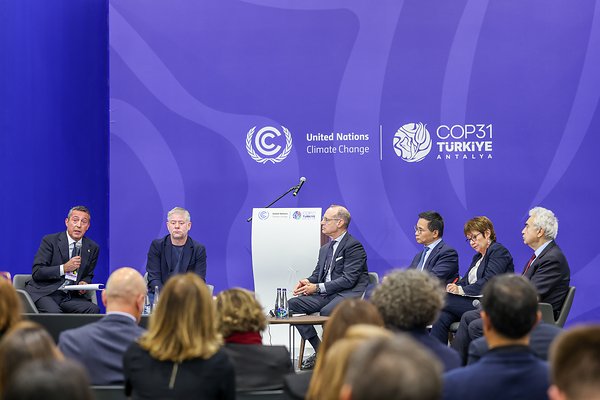
At COP31's Highly Sensational Panel, the Impact of Climate Policies on Global Competition Was Discussed
As part of COP31 for which Koç Holding is a Global Business Partner, the panel discussion 'From Commitments to Action: The Role of Business and Policy in the Global Climate Agenda' was held. The event which began with an opening address by COP31 President Murat Kurum featured former US Vice-President Al Gore as keynote speaker.
Speaking at the panel moderated by IEA Executive Director Fatih Birol, Koç Holding Vice-Chair of the Board of Directors Ali Y. Koç said, "Energy has moved beyond being merely a cost factor in industry to becoming a decisive factor in global competition." Noting that governments are establishing domestic industrial infrastructures centred on energy independence and resilience, Koç affirmed that the essence of the energy transition lies in the widespread adoption of electrification and domestic clean energy investments.
ANTALYA, Türkiye, Nov. 11, 2026 /PRNewswire/ -- As part of the United Nations Climate Change Conference (COP31) for which Koç Holding is as a Global Business Partner, the panel discussion 'From Commitments to Action: The Role of Business and Policy in the Global Climate Agenda' was held on 10 November. The event began with an opening address by Murat Kurum, Turkish Minister for the Environment, Urbanisation and Climate Change and President of COP31, and featured former US Vice-President Al Gore as keynote speaker. Following the speeches, a panel discussion took place, moderated by Dr. Fatih Birol, Executive Director of the International Energy Agency (IEA), whilst Ali Y. Koç, Vice-Chair of the Board of Directors of Koç Holding; Lei Zhang, Founder and CEO of Envision Energy; Oliver Bäte, CEO of Allianz; Odile Renaud-Basso, President of the European Bank for Reconstruction and Development (EBRD); and Greg Jackson, Founder and CEO of Octopus Energy, took part as panellists.
From Commitments to Action: The Role of Business and Policy in the Global Climate Agenda
Congratulating Turkey on hosting COP31, former US Vice-President Al Gore said: "I would like to point out that we are fortunate to have all the technologies we need to reduce emissions. Tell future generations that we, who were alive in 2026, took action to fulfil our responsibilities. We not only possess the technologies, but also proven models of implementation. The only thing some people think is lacking is sufficient political will. However, please do not forget that political will itself is a renewable resource."
COP31 President Murat Kurum: "We see COP31 as the COP of solutions"
Turkish Minister for the Environment, Urbanisation and Climate Change and President of COP31 Murat Kurum underlined that COP31 will be a summit focused on implementation and action, drawing attention to the challenges faced by the business community in terms of finance, technology and investment in the context of the climate transition. Kurum stated, "From the day we assumed the presidency of COP31, we made a promise to the whole world. We said that this COP will be a COP of implementation and action. We know that the business community needs predictable policies to be able to make long-term investments. Companies can struggle to find affordable, long-term financing for the projects they develop. The risks associated with the initial implementation of new technologies can delay investment decisions. In particular, our small and medium-sized enterprises are in need of technical expertise, skilled human resources and support in project preparation. As large companies undergo transformation, the fact that suppliers are left behind makes it difficult for the entire value chain to progress. Moreover, our businesses are also facing the effects of climate change on production and logistics. We need global-level investment in adaptation across many areas, from access to water and facility security to employee health and supply continuity."
Highlighting the importance of collaboration between the public sector, the private sector and financial institutions in climate action, Kurum expressed that, as the COP31 Presidency, they aim to strengthen the investment environment and facilitate access to finance and technology. Kurum continued: "We must therefore strengthen cooperation between the public sector, the business community and financial institutions at every stage of investment. As COP31 participating countries, we are also aware of our responsibilities towards the business community. As a global community, we must ensure a predictable investment climate and facilitate access to finance and technology. Whilst scaling up successful solutions, we must strengthen the capacity of our businesses and workers, and develop collaboration with the private sector to ensure that the opportunities offered by the transition reach all sectors. We view COP31 as a 'the COP of solutions' that addresses these needs. Through our Presidency's approach based on dialogue, consensus and action, we have positioned the business community as a key partner in implementation."
Ali Y. Koç: "The energy transition is not just a climate priority, but also an economic necessity"
Opening his remarks by noting that 10 November is a day of great significance for Turkey, Ali Y. Koç, Vice-Chair of the Board of Directors of Koç Holding declared, "Today, we commemorate Mustafa Kemal Atatürk with respect and gratitude. His belief in science, progress and leaving a lasting legacy for future generations remains as important as ever in the context of the issues we are addressing today."
Ali Y. Koç then went on to explain, "Energy has moved beyond being merely a cost factor in industry to becoming a decisive factor in global competition. The rules of competition in industry have changed more in the last 10 years than they did in the previous 50," pointing out that a completely new economic order is taking shape. Koç added, "We were all in favour of free global trade. Now, however, countries are turning inwards. Rather than purchasing goods from wherever they can source them at a slightly lower price, they are developing their own domestic industrial capacity. The best price is no longer the lowest one. Countries are now building new worlds. At the heart of it lies the objectives of economic independence, resilience and greater competitiveness. Consequently, this new equation means energy transition, energy independence and economic competitiveness. For this reason, reducing fossil fuel use is no longer merely a priority, but an economic necessity. I believe this presents an opportunity from a climate perspective. Because even if countries, governments and leaders do not take action on their own to lower the planet's temperature, they will certainly act in their own interests. Thus, climate targets and economic interests are no longer competing priorities. This gives us hope for collective action. It allows us to see more light at the end of the tunnel."
Ali Y. Koç: "COP31 should be remembered for the investments it paved the way for and the projects that were implemented"
Noting that the energy transition is more aligned with climate targets than ever before, Koç observed, "COP31 must pave the way for new policies that tackle climate issues in areas where there is no profit to be made. COP31 should be remembered not for the commitments announced, but for the investments mobilised, the projects implemented and the emissions reduced." Koç proposed that COP31 develop a scorecard enabling countries to track investments in necessary projects, covering not only the construction of production capacity but also the entire infrastructure required. Koç elaborated: "Let us not forget that in 2015, fossil fuels accounted for 90% of primary energy sources. Much has been achieved over the past decade, and significant investments have been made. Nevertheless, this figure still stands at 86%. That is why, in this new economic order, we all still have a long way to go to change this scene."
IEA Executive Director Dr. Fatih Birol: "Close dialogue is more important than ever"
Dr. Fatih Birol, Executive Director of the International Energy Agency, noted that in the midst of the major energy shock triggered by the war in Iran, many countries are reassessing their energy strategies to reduce their vulnerability to volatile fuel markets. Birol commented: "In this process, technologies that support electrification and energy efficiency are expected to come to the fore, alongside low-emission sources such as renewable and nuclear energy. This is creating an increasingly strong alignment between energy security and climate targets, particularly for fuel-importing countries. In such a dynamic environment, close dialogue between governments and the business community on how to ensure safe, affordable and sustainable energy for all citizens is more important than ever."
European Bank for Reconstruction and Development (EBRD) President Odile Renaud-Basso remarked, "The green transition is one of the greatest economic opportunities of our time. It can help build more resilient, efficient and competitive economies. We must seize this opportunity and accelerate the pace of implementation."
Allianz CEO Oliver Bäte weighed in, "'We can keep the world insurable; yet, it requires policy clarity and consistency alongside sufficient investments in adaptation and resilience."
Emphasizing their positive outlook for the future, Envision Energy Founder and CEO Lei Zhang expressed, "I am optimistic for the future. There is such an abundance of renewable energy available to us that we have the opportunity to create a new prosperity for humanity in the coming decades. We have the technology and the systems to do it."
Koç Holding is the Global Business Partner of COP31
Ali Y. Koç, Vice-Chair of the Board of Directors, Koç Holding
Source: PRNewswire

Leave a comment
Comments are closed on this post.