
In Shenzhen, Luo helped identify biotech companies worth approaching for listing preparation. In California, she uses purchasing patterns and laboratory needs to decide where to develop the next research account.
Palo Alto, November 19, 2026 -- Before arranging an instrument demonstration, Li "Vivi" Luo collects information about the laboratory's samples, extraction procedures, input volumes and downstream experiments. Her written guidance for colleagues starts with the customer's existing work. The information helps determine what to demonstrate, which technical specialists to involve and how researchers can compare a proposed system with their current process.
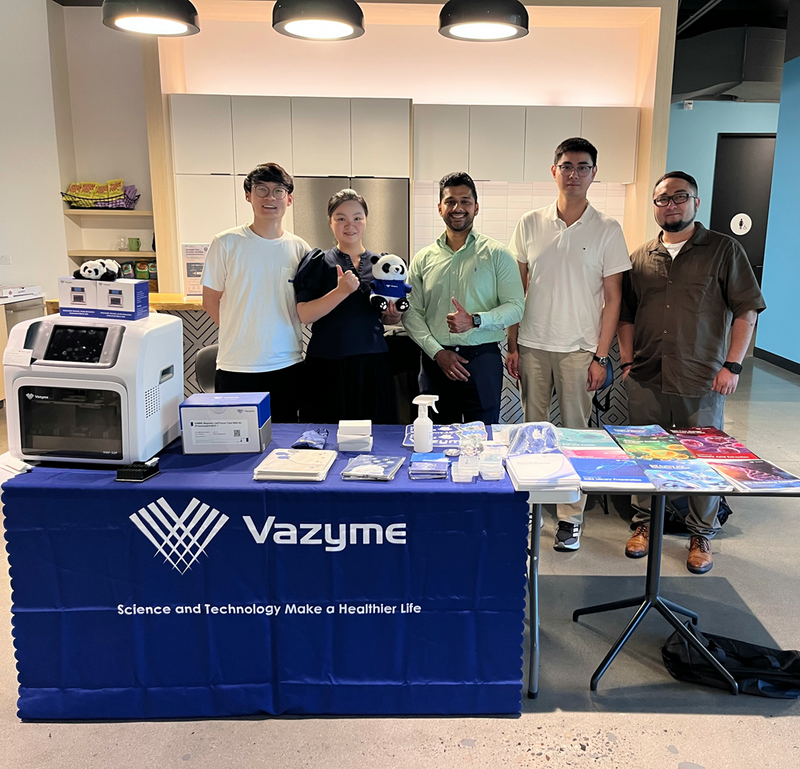
Luo works in strategic account management and research customer development at Vazyme International LLC, which she joined in May 2023. As a supervisor, she develops U.S. research accounts with a focus on Northern California, including labs at Stanford University and the University of California, San Francisco. She also works with researchers in Seattle at the University of Washington and Fred Hutchinson Cancer Center.
An earlier expression of that interest was Next IPO, a company-screening product at V-Next, the technology-and-capital platform operated by Shenzhen Securities Information Co., Ltd. within the Shenzhen Stock Exchange group. Luo worked at V-Next from 2018 to March 2023. In 2021 and 2022, she contributed to adapting Next IPO, also known as Youqicha, to the biopharmaceutical sector.
Former V-Next director Bin Yu describes that contribution in a signed account. Luo participated in project planning, model development, coordination across departments and validation. She researched the industry's characteristics and helped coordinate access to databases used in the screening process. The task required understanding life science businesses well enough to make the model useful for that sector.
According to Yu, Luo analyzed industry data covering more than 10,000 relevant companies and applied the model to identify more than 80 high-potential businesses for further listing preparation and engagement. For the team responsible for outreach, the shortlist narrowed a broad search to a specific decision: which companies to contact about preparing for a potential listing.
The work also required collaboration. Data access, model development and business follow-up involved different responsibilities, and Luo's contribution extended across those stages. Yu places her work within the product's earlier development and industry application. His account describes a commercial professional connecting sector research with a tool that other people could use in their decisions. Her earlier work with Finnish technology firms helps explain why that distinction mattered. Luo organized a Nordic investment roadshow and a roundtable at Slush Shanghai in 2019. Across the wider collaboration with Business Finland, more than 90 Finnish companies participated and more than 30 business and investment introductions followed, according to Yu.
Yu also records her work on user segmentation and V-Next's business database. In her U.S. role, she reviews purchasing patterns, recent customer interactions and progress toward a purchase to set priorities for her sales team. A repeat order may call for a discussion about supply, while a lab that has just completed a trial may be ready to review results.
Her present work asks a related question at the laboratory level: which research need justifies a closer evaluation? In her instrument-promotion materials, Luo asks whether extraction is manual, how many samples a team processes and whether several people share the procedure. These questions give a sales discussion a concrete basis. They help distinguish curiosity about a product from a need that researchers are prepared to investigate.
Sample volume is one consideration. Her guidance also identifies reproducibility, standardization, shared use and plans for expansion as reasons a smaller laboratory might consider automation. The assessment therefore includes how work is organized. A laboratory with modest throughput may still have a reason to evaluate a different procedure, particularly when several researchers depend on consistent preparation.
"Never decide for the customer," Luo writes in the training material. "Always give them the opportunity to evaluate automation." The instruction leaves the adoption decision with researchers while giving the commercial team a clear responsibility: prepare an evaluation that addresses their actual questions.
That preparation becomes specific before a demonstration. Luo's materials call for identifying sample types, the current DNA or RNA workflow, expected output and the experiments that follow extraction. Wherever possible, the evaluation uses the customer's own samples and changes only the extraction method. Researchers can then compare results under conditions relevant to their work, with technical support available to address problems.
Information gathered during evaluation also shapes the next commercial step. A positive demonstration may lead to data review, a quotation or a discussion about budget approval. Her guidance follows the process through purchasing, installation and continuing reagent needs. Where several users share a reagent, bulk ordering and split shipments can help a lab match deliveries to its expected use. The purchasing discussion draws on information Luo began gathering before the demonstration.
The approach requires colleagues with different expertise. Product specialists help researchers interpret a trial, while the operations team works out how to keep a shared instrument supplied. Luo brought that experience into her own team after becoming a supervisor in March 2025. Her manager, Dong Wang, reports that she ranked first among research sales employees of Vazyme’s U.S. subsidiary in 2023, 2024 and 2025.
Across the two settings, the decisions remain distinct. Next IPO screened businesses for further engagement; laboratory customer development concerns whether researchers should evaluate and adopt a tool. The connection is a working method: understand the relevant context, organize the information and use it to choose a specific next step. For Luo, data-driven commercialization takes shape in those decisions, from a biopharmaceutical company shortlist to a laboratory demonstration designed around real samples.
Contact Info:
Name: Yan Rong
Email: Send Email
Organization: Vazyme International LLC
Website: http://www.vazymeglobal.com
Release ID: 89210132
If you detect any issues, problems, or errors in this press release content, kindly contact error@releasecontact.com to notify us (it is important to note that this email is the authorized channel for such matters, sending multiple emails to multiple addresses does not necessarily help expedite your request). We will respond and rectify the situation in the next 8 hours.
Source: MarketersMedia



Leave a comment
Comments are closed on this post.